
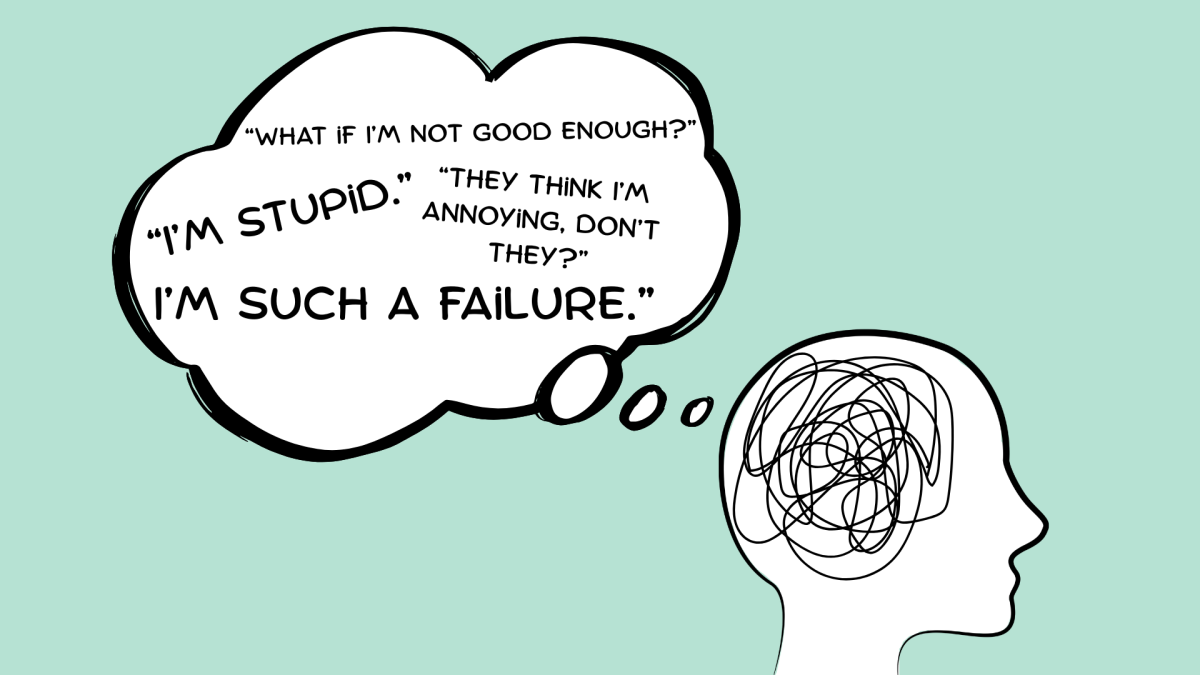
“What if I offend them?” “What if I say something dumb?” “What if I get hurt or sick?” “I’m a failure.” “I’m so stupid.” “Why can’t I do things correctly?” “They think I’m annoying, don’t they?” “I’m a bad person.”
Sound familiar? Thoughts like these and many more plague many people’s minds; you’re not alone. Even mine while trying to write this! Back and forth. Day and night. I was drowning in overwhelming thoughts and scenarios.
As college students, we deal with a lot of anxiety. According to a study done at TransformingEducation.org, about 41% of college students have reported having symptoms of anxiety, and nearly half of college students have reported experiencing feelings of overwhelming anxiety; 57% being female and 40% being male.
So, let’s take a breath here, we’re not crazy, you’re okay. But you’re probably wondering, why you might have such terrible thoughts out of nowhere. What are they?
For starters, our creepy thoughts are not a nameless enemy. Automatic Negative Thoughts or ANT’s, as defined by The National Library of Medicine are “An individual’s immediate, unpremeditated interpretations of events.” (Suma P., Chand Daniel P. Kuckel, Martin R. Huecker., 2023) In other words the random thoughts you have that just pop into our heads when going about daily life for no rhyme or reason.
We tend to not be aware of our automatic thoughts, or many people can just let these thoughts pass by without mulling over them.
This occurrence was studied by Aaron Beck, who created Cognitive behavioral therapy (CBT), a type of therapy that is still used today. But the term ANTs were coined by Dr. Daniel Amen in 1990’s. He realized that ANTs seem to be affected by one’s view of themselves, other people, and the world or situation around them, and they can have an effect on our behavior.
For example, if a friend canceled plans with you and you have the thought of “They must hate me. They don’t even want to be around me!” You may avoid your friend the next day, when in reality they were just busy. So how do these usually random thoughts become so hurtful?
ANTs like I had mentioned earlier, are very normal to experience. But when we start to ruminate and examine every single thought that comes into our mind, we start to believe them. Especially when they are so close to our values. Because after all, when things are in our head, we believe them to be true. Even though you know these thoughts are unhelpful, hurtful and irrational, it’s hard to doubt what your own mind is telling you.
These negative messages can have a serious effect on our mental health. An article by ClevelandClinic.org psychologist, Susan Albers, talks about the ways negative thinking can affect your physical and mental health from:
- Increased anxiety
- Feelings of depression
- Constant worrying
- Low self-esteem/confidence
So how do we start to help ourselves manage these ANTs in a healthy way?
1) Recognize the negative thinking traps
I’m guilty as charged for many of these thought patterns. Being able to recognize these patterns will help you be more mindful of the negative patterns and to be able to challenge them.
Here are some of these negative thought patterns, they include:
- All or Nothing thinking “If I fail this test, I’m a failure forever.”
- Over Generalization “Everything in my life is terrible and it will always be terrible.”
- Selective Attention “My boss thinks I did a terrible job today.” (In reality they told you did a great job today just to stay focused a bit more on task.)
- Mind reading “She’s only asking me for extra information because she doesn’t believe me; I know they’re saying bad things about me when I’m not there.”
2) Challenge the negative thoughts
Like I mentioned before, challenging these thoughts is super helpful. In my experience, writing things down has always helped clear my head. It’s called Socratic Questioning. Basically, what you do is break the thought apart. For example:
- What emotions am I feeling right now?
- What evidence do I have to prove that that is true? What evidence do I have to prove that it’s not true?
- What’s a different way to look at this?
- What’s the most realistic outcome?
3) Confiding in a friend or a professional
I was told by my counselor during one of our sessions that sometimes saying the negative thing out loud can help you gain perspective.
Talking to a trusted friend about your ANTs can help you analyze and break down what’s really going on. Having an outside perspective, it’s been very helpful for me personally. And if you unfortunately don’t have a trusted group of friends, a therapist, counselor or even a mental health coach can also help you with this process.
Here at HCC, they have mental health services that can assist you if you need it. I’ve used them for two semesters now and I’ve been very grateful for the help that I’ve gotten.
Once again, I want to tell you that you’re not alone! And please don’t hesitate to reach out for help if you need it. Do what you need to take care of yourself. You’re doing great and you got this!